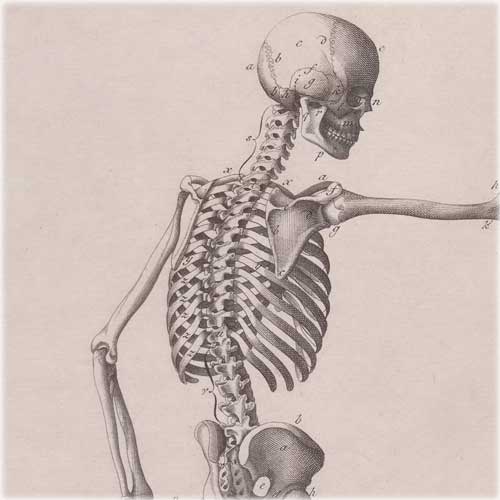
The spine has become an almost ubiquitous symbol to the modern eye, perceived as a grimly beautiful element of the Gothic aesthetic and our fascination with all things skeletal. Yet throughout the ancient world, the spine held a far deeper spiritual significance, one that has largely been lost in modern thinking.
In Eastern philosophies, the spine was regarded as the conduit of consciousness. Kundalini was believed to be a dormant spiritual life force, coiled at the base of the spine, which, when awakened, rises through the central spinal channel, or Sushumna, passing through the seven primary chakras. This ascent was said to bring expanded consciousness, spiritual enlightenment, and renewed physical vitality.
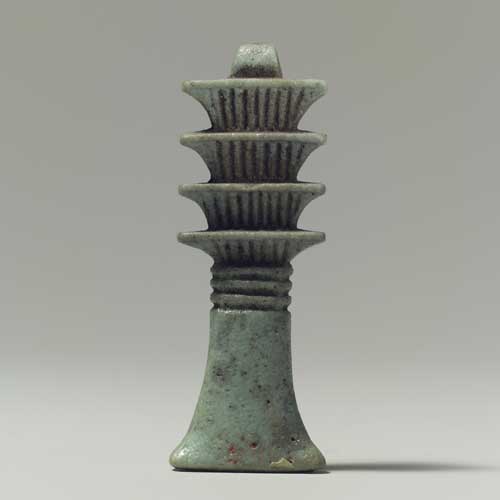
A remarkably similar symbolism can be found in ancient Egypt. In the myth of Osiris, after his brother Seth murdered him and scattered the pieces of his body across the land, Isis painstakingly gathered them together and restored him to life. The Djed pillar came to represent the reconstructed spinal column of Osiris, embodying the strength, stability, and resilience that enabled him to rise from the dead. Beyond the myth itself, the Djed was one of the most powerful symbols of protection and resurrection in Egyptian religion. It was frequently painted along the spine of sarcophagi and fashioned into amulets to safeguard the dead, preserving the integrity of the body and ensuring eternal life.
Separated by vast distances and cultures, both Eastern and Egyptian traditions recognised the spine as far more than a structural support for the body. It was seen as the axis of life itself—a sacred channel through which consciousness, vitality, and ultimately rebirth could be achieved.
Few of us have escaped the cost of living crisis created by the political and economic chaos that’s dominated the headlines in recent years, unleashed by the likes of dictators such as Vladimir Putin. Hefty energy bills have impacted on everyone’s budgets, while at Alchemy we’ve also been hit hard by the rising price of materials. Particularly metal, which has soared in price; global conflicts have created an increasing demand for arms & munitions, AI data centres consume vast amounts in their electronics, and this, all added to the recent disruption of its principle supply from Southeast Asia. Alchemy’s core medium is pewter, which is 92% tin, which although might not seem an obvious component in AI or military manufacture, this and its other alloyed component metals are essential to countless modern industries. In January, headlines announced ‘Tin hits all-time high’, having risen in price to almost double in 12 months. As Alchemy refuses to compromise on quality – the elegance, detail, and durability that we pride ourselves on – we too are facing spiralling costs.
It was way back in 1997, the year following Dr. von Rosenstein’s public debut, and the revelation of his historically sensational introduction of what he termed as ‘The Art of Science’, that Alchemy Gothic released a scale replica of one of his most triumphant, though markedly controversial and spectacular achievements - the Humunculus.
‘Any sufficiently advanced technology is indistinguishable from magic.’ Arthur C. Clarke
On 1st January 2027, Alchemy will begin its celebration of 50 years since its inception, in 1977.
With the originators still actively at the helm and passionately keen on continuing to lead the way in alternative, extraordinary design, this year of 2025 has seen Alchemy Gothic surpass its 1,000th pendant, or neckwear design.
To purchase Alchemy Gothic products visit the Alchemy Dealer List - Trade Customers visit www.alchemyengland.com
Privacy Policy. Site Map. Friends of Alchemy.